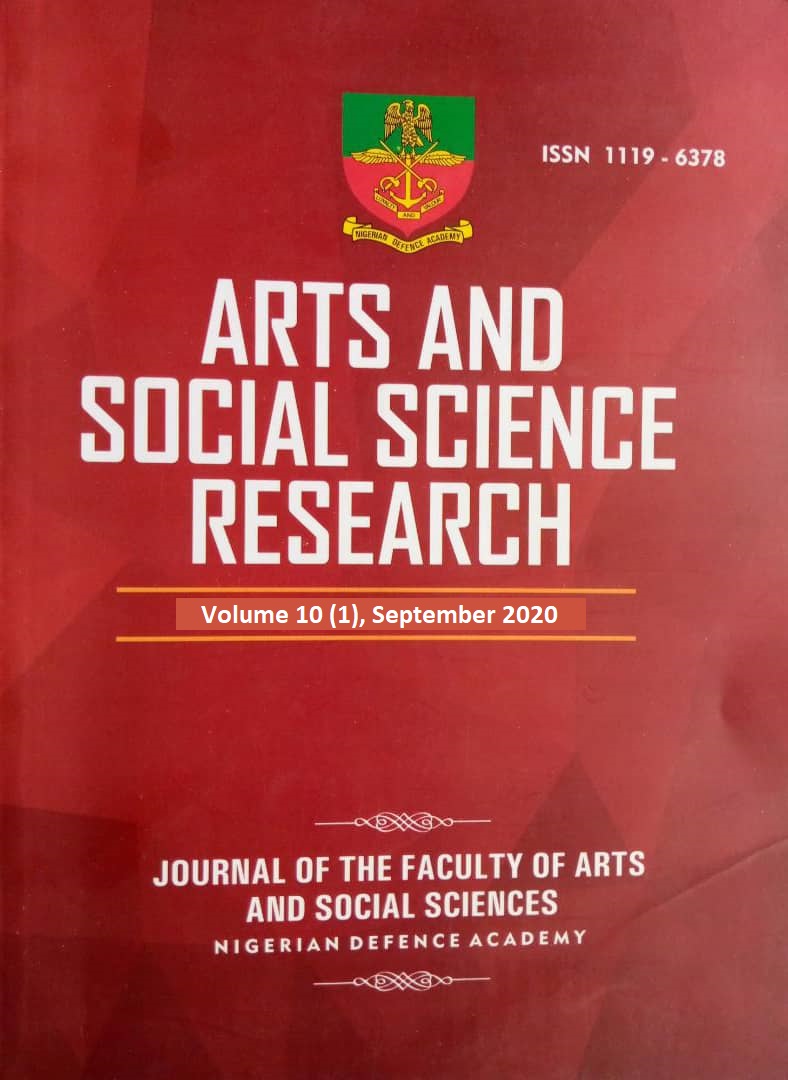
INSTITUTIONAL RESPONSES TO THE IMPACT OF GLOBAL CLIMATE CHALLENGES ON AFRICA: THE CASE OF NIGERIA SECURITY AND CIVIL DEFENCE CORPS
Keywords:
Institutional Response, Global Climate Challenges, Climate Change Mitigation, Climate Change Adaptation, NSCDCAbstract
Recently, Africans have been experiencing serious climate conditions such as fluctuating rainfall, temperature rise, increase in sea level and flooding, desertification, drought, land degradation, more recurrent extreme weather condition, affected freshwater resources, and loss of biodiversity. These conditions have led to seasons of drought and excess flood, which affected the health of the people, and agricultural activities and caused a loss of shelter, especially in Nigeria. This means that the role of the Nigeria Security and Civil Defence Corps (NSCDC) cannot be ignored in responding to the climate challenges in Nigeria. Therefore, this paper presents the conceptual framework, sources of climate change, consequences of climate change, climate change policy in Nigeria, and the response of NSCDC to the climate challenges in Nigeria. It concludes that Africa has to adapt to the effects of climate change and mitigate the negative impact of climate change at the national and individual levels. It, therefore, recommends among others that, the government at all levels should collaborate with stakeholders in the relevant ministries/agencies to ensure that policies are revised and implemented based on current environmental needs and challenges.
Downloads
Published
How to Cite
Issue
Section
License
Copyright (c) 2023 Author(s)

This work is licensed under a Creative Commons Attribution 4.0 International License.
The publications on this website is licensed by Creative Commons Attribution 4.0 International (CC BY 4.0). This is an open access journal which means that all content is freely available without charge to the user or his/her institution. Users are allowed to read, download, copy, distribute, print, search, or link to the full texts of the articles, or use them for any other lawful purpose, without asking prior permission from the publisher or the author. However, authors retain copyright and full publication rights.