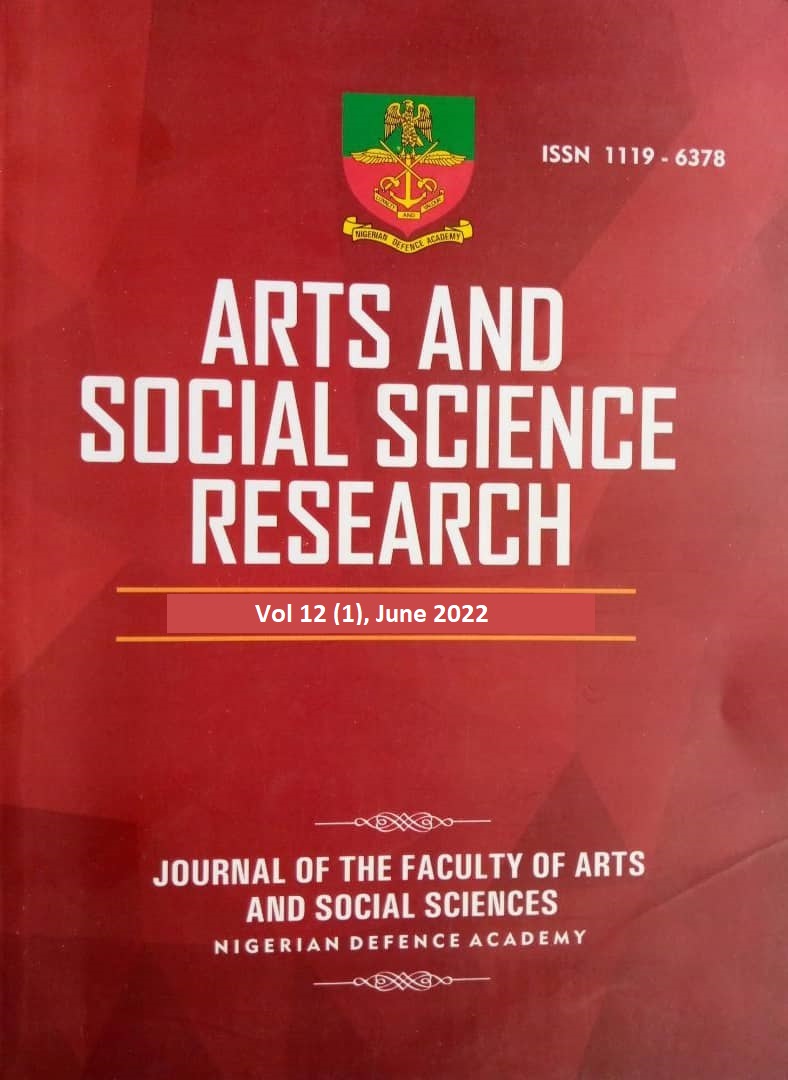
THE INFALLIBILITY OF THE SUPREME COURT AND THE CHALLENGES OF DEMOCRATIC CONSOLIDATION IN NIGERIA, 1999 - 2019
Keywords:
Supreme Court, Democratic consolidation, INEC, Nigeria, Political ParticipationAbstract
The Supreme Court of Nigeria (SCN) is the highest appellate court in the country. The decision of the court and its actions are not only final but are seen as infallible and sacrosanct. The Supreme Court and its application in various electoral cases have generated mixed feelings and raised questions on the credibility of the Nigerian judiciary and its capability of ensuring sustainable democracy in the country. This study examines the infallibility status of the Supreme Court of Nigeria and the challenges of democratic consolidation in the country, from 1999 to 2019. The study is anchored on the doctrine of absolute political theory. The secondary data used in this study were drawn from documentary facts generated from an array of both published and unpublished materials such as textbooks, journals, magazines, newspapers, conference and seminar papers, internet materials, reports of electoral tribunals of the election, and many more. Primary data was generated using the interview method, which combines key informants’ interviews and focused group discussions. In interpreting the data, the relationship was established between the infallible status of the Supreme Court on electoral issues and its implication on Nigerian Democracy. Empirically, the study used a qualitative and historical method that is critical and analytical in providing descriptive and historical details. This was complemented by descriptive quantitative analysis. In doing that, the information gathered was summarized and processed through a statistical package for social science (SPSS). The study found that the infallibility of the Supreme Court verdicts on electoral issues has a significant effect on sustainable democracy in Nigeria. The study recommends among others that there is a need for radical reform and overhaul in the judiciary and judicial process, independence of INEC, and many others.
Downloads
Published
How to Cite
Issue
Section
License
Copyright (c) 2023 Author(s)

This work is licensed under a Creative Commons Attribution 4.0 International License.
The publications on this website is licensed by Creative Commons Attribution 4.0 International (CC BY 4.0). This is an open access journal which means that all content is freely available without charge to the user or his/her institution. Users are allowed to read, download, copy, distribute, print, search, or link to the full texts of the articles, or use them for any other lawful purpose, without asking prior permission from the publisher or the author. However, authors retain copyright and full publication rights.